


The first year of the project “The Marsh Fritillary (Euphydryas aurinia) in Dry Habitats in Germany” has already passed. The focus this year was on ecological studies of the habitat use by the Marsh Fritillary. In our initial investigation of the butterfly’s presence in the study area, we wanted to determine whether the species uses its habitats consistently or if there is a pattern of colonization dynamics. An intensive butterfly mapping survey was conducted and compared with the results of a biotope survey from 2019. This allowed us to show that some habitats were only used in a single survey year, while others were consistently inhabited or not inhabited at all.
In addition, comprehensive analyses of functional connectivity were carried out, a distance measure that considers the spatial resistances of the surrounding environment. As a typical metapopulation species, the local populations of E. aurinia are connected through occasional exchanges of individuals and are thus dependent on a well-connected network of habitats. However, many suitable habitats are now isolated and surrounded by forests.
If the current distribution of a species is better explained by historical rather than current landscape structure, an extinction debt is typically assumed. This phenomenon describes the expected delayed extinction in response to environmental deterioration. In such cases, a species’ occurrences are largely due to past environmental conditions, which are no longer met today, thus only allowing short-term survival of the population, for example, because local subpopulations are now too isolated (more information on our studies can be found under “Ecological Studies”). Since both the Marsh Fritillary and its habitat, the valuable “Buckelwiesen”, have significantly declined over recent decades, this phenomenon may also be playing a role in our study area. Therefore, in the 2023 project year, historical aerial photographs were georeferenced and analyzed to assess the potential extinction debt of the Marsh Fritillary.
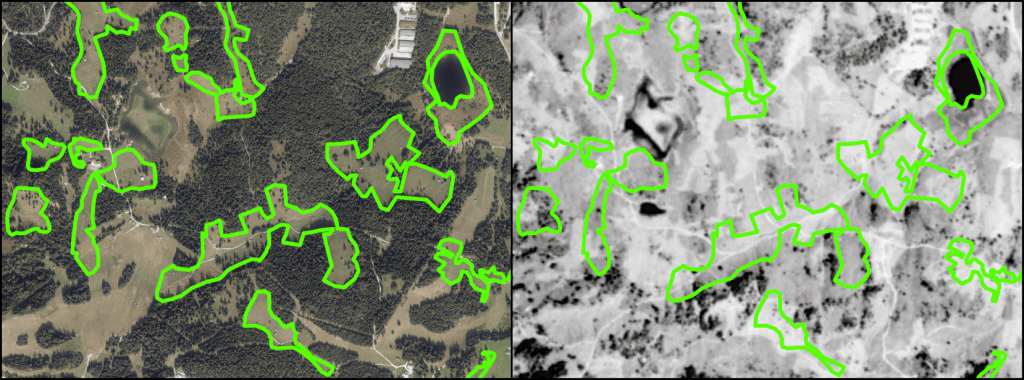
The illustration shows the same landscape section today (left) and in 1953 (right). The current location of the “Buckelwiesen” is marked in green in both images.