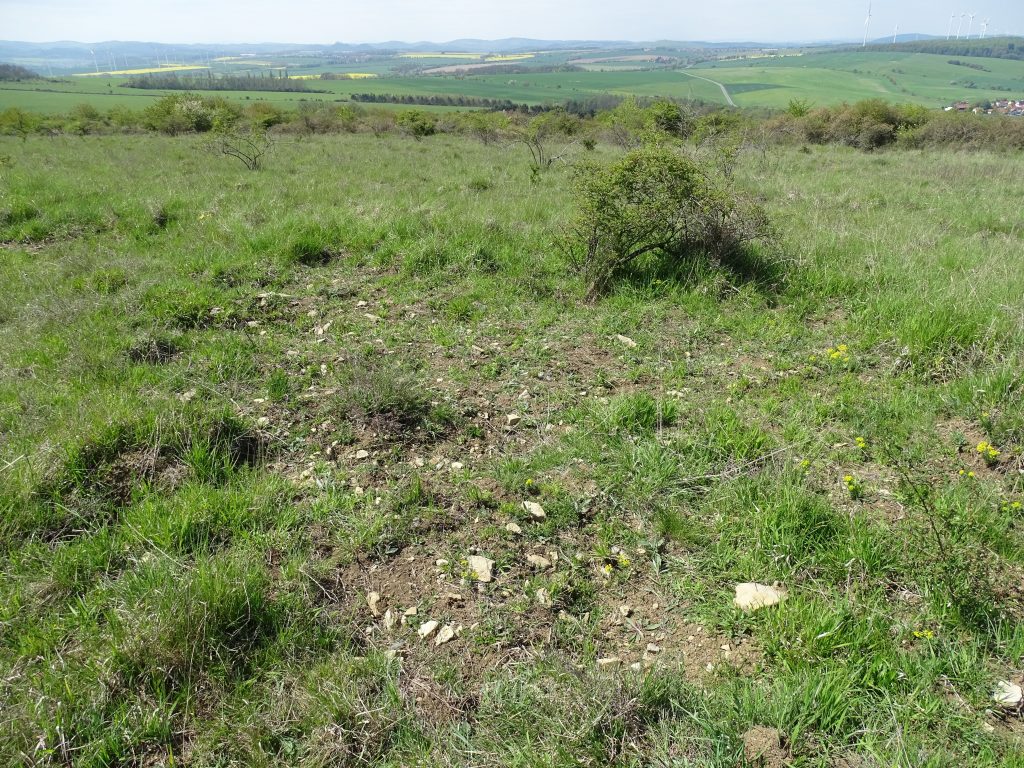


Wild boar as ecosystem engineers conserve rare butterflies in abandoned grasslands
Wild boar (Sus scrofa) are ecosystem engineers that can reshape landscapes. Their natural rooting behaviour disturbs the soil and resets successional processes in grasslands, creating open swards rich in bare ground and exhibiting a warm microclimate. However, the effects of the soil disturbance by wild boar are often controversially discussed. To shed light into the role of rooting for butterflies in abandoned calcareous grasslands we analysed the effects soil disturbance by wild boar on two rare butterflies: marsh fritillary (Euphydryas aurinia) and Nickerl’s fritillary (Melitaea aurelia) in the Hainich National Park, Germany, in a study, recently published in Global Ecology and Conservation. For that purpose, we sampled different environmental parameters as well as butterfly frequency and abundance in wild boar rootings and undisturbed calcareous grasslands. Our study revealed that both rare butterflies vitally depend on rooting for reproduction – juvenile stages of M. aurelia were even solely found within rootings. As soil disturbing ecosystem engineers wild boar created early seral stages rich in bare ground, hence a warm microclimate, which is important for larval development. However, for both butterfly species, the most important parameters defining habitat quality were host plant abundance and biomass. Due to rooting removing dominant grasses and the dense litter layer, the light demanding host plants of the butterflies got heavily promoted. Based on our study, high densities of wild boar and additionally wild herbivorous ungulates, which slow down the expansion of woody plants by browsing, can help to preserve open habitats like calcareous grasslands and their unique biodiversity.